There is a hard truth of the trade that every apprentice must learn: 90 percent of a successful weld happens before the arc is ever struck. In the heavy industrial sector, from structural steel yards to pipefitting fabrication shops, professionals cannot simply slap two pieces of metal together and pull a trigger.
Structural integrity relies entirely on how the metal is prepped, angled, and clamped. If the joint preparation is flawed, the weld will fail X-ray inspection, regardless of how aesthetically pleasing the final bead looks. Acquiring these fundamental fabrication skills is a primary focus of any comprehensive Welding Training Program.
In this article, we break down the five basic welding joints, detailing the specific preparation requirements, optimal fit-up techniques, and execution standards required to pass strict building and manufacturing codes.
Key Takeaways
- Preparation is Mandatory: Failing to grind away mill scale, rust, or oil will instantly introduce porosity and trap slag inside the weld pool, leading to structural failure.
- Butt & Tee Joints: The heavyweights of the industrial sector. Butt joints provide full penetration for high-pressure pipes, while Tee joints utilize fillet welds for heavy structural steel framing.
- Lap & Edge Joints: Frequently utilized in the sheet metal, auto-body, and HVAC industries. These joints require strict heat control to prevent burning through the thin base metals.
- The Fit-Up Process: Precise measuring, tack-welding, and clamping are required to prevent thermal distortion (metal shrinkage) from pulling the joint completely out of square as it cools.
The Crucial Role of Preparation and Fit-Up in Metal Fabrication
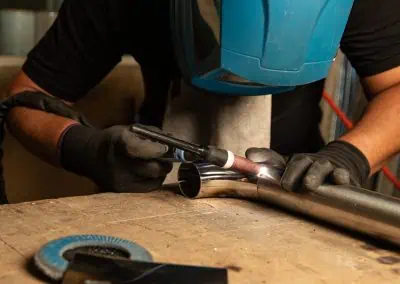
A strong weld pool has four primary enemies: rust, oil, paint, and mill scale. Mill scale is the dark, flaky iron oxide layer that forms on hot-rolled carbon steel during the manufacturing process. Failing to strip the metal down to bare, shiny steel using an angle grinder will immediately contaminate the weld.
Once the metal is clean, the “fit-up” begins. This is the rigorous process of aligning, measuring, and tack-welding the pieces into their exact blueprint positions. A tack weld is a small, temporary bead used to hold the metal in place. Proper clamping and tacking are vital because welding generates massive heat. As the liquid metal cools, it shrinks rapidly, creating thermal distortion that will pull a poorly secured joint entirely out of alignment.
1. The Butt Joint: High-Stress Pipe and Plate Fusion
A butt joint is formed by placing two pieces of metal side-by-side in the exact same plane. Because the edges are butted completely flush against one another, it is the standard joint for cross-country pipelines and high-stress industrial vessels.
Beveling and Root Openings
If the carbon steel plate or pipe is thicker than 3/16 of an inch, the welder cannot simply butt the square edges together. To achieve full penetration, they must grind a “bevel” (typically a 30 to 37.5-degree angle) on both edges, creating a V-groove.
When fitting the joint, the fabricator leaves a deliberate gap between the two plates known as the root opening. This gap allows the initial weld pass (the root pass) to penetrate completely through to the back side of the joint.
Common Industrial Applications
Because they offer unmatched strength, full-penetration butt joints are heavily utilized in industrial refineries. These joints are strictly governed by American Society of Mechanical Engineers (ASME) codes and are frequently subjected to Radiographic Testing (RT). Inspectors literally X-ray the joint to ensure there are zero internal defects hidden beneath the surface.
2. The Tee Joint (T-Joint): The Structural Heavyweight
A tee joint occurs when two pieces of metal intersect at a 90-degree angle, forming the shape of a ‘T’. This configuration is the absolute backbone of the commercial construction industry.
Fillet Welds and Penetration Profiles
Tee joints are almost universally fused using a fillet weld. Execution relies entirely on the operator’s torch angle. To achieve proper penetration into the root of the joint, the welder must hold a precise 45-degree work angle. This ensures the 6,000-degree heat is distributed equally between the vertical web and the horizontal flange.
Avoiding Lamellar Tearing in Heavy Carbon Steel
Tee joints introduce a severe metallurgical risk known as lamellar tearing. This is a catastrophic internal cracking that occurs in thick, heavy steel plates due to extreme shrinkage stresses as the weld pool cools. To prevent this, structural engineers often require specific pre-heating of the base metal before the arc is struck to slow down the cooling rate and relieve the stress on the joint.
3. The Lap Joint: Overlapping Metal for Shear Strength
A lap joint is formed when two pieces of metal overlap one another. It is frequently utilized on sheet metal where aligning a flush butt joint would be too difficult.
Managing Burn-Through on Thin Materials
The execution challenge of a lap joint is heat management. The welder must melt the edge of the top plate down into the flat surface of the bottom plate. If the machine’s amperage is set too high, or the welder’s travel speed is too slow, the arc will cause “burn-through,” melting a hole straight through the thin top edge and ruining the workpiece.
Manufacturing and Auto-Body Applications
Lap joints offer exceptional shear strength under load. Because of this, they are the industry standard in auto-body repair shops, HVAC ductwork fabrication, and custom trailer manufacturing.
4. The Corner Joint: Box Frames and Enclosures
A corner joint connects two pieces of metal at a 90-degree angle. Unlike the tee joint, the metal is joined at the extreme outside edges to form a box or an ‘L’ shape.
Open vs. Closed Corner Configurations
- Closed Corner: The edge of one plate sits entirely flush against the inside face of the other. It is easier to weld but offers less penetration.
- Open Corner: Both edges meet perfectly at the outside points, leaving a V-shaped gap on the exterior. This is preferred for high-strength enclosures because the gap allows the filler metal to achieve full joint penetration.
Sheet Metal Fabrication in Climate-Controlled Shops
Corner joints are heavily utilized in manufacturing aluminum toolboxes, electrical enclosures, and custom fluid tanks. Professionals generally utilize the GTAW (TIG) process on these joints to achieve aesthetic, perfectly stacked weld beads.
5. The Edge Joint: Joining Parallel Plates
An edge joint connects the adjacent edges of two parallel pieces of metal. It is rarely used for heavy, load-bearing applications.
Flanging and Edge Preparation
Edge joints are almost exclusively found on very thin sheet metal, such as automotive exhaust mufflers or aerospace skins. To execute this, the edges of the metal are often “flanged” (bent upward). This allows the operator to melt the two protruding edges together without even needing to add a filler rod, a highly specialized technique known as an autogenous weld.
Essential Tools for Metal Prep: Grinders, Bevelers, and Wire Brushes
To properly prepare these five joints, every fabricator must maintain a specific arsenal of abrasive tools. Learning to operate this equipment safely and effectively is one of the first fundamentals taught in an approved Welding School. The absolute necessities include:
- 4.5-inch Angle Grinder: The workhorse of the fabrication shop.
- Hard Grinding Discs: Utilized for cutting deep bevels into thick carbon steel.
- Flap Discs: Sandpaper-like wheels used to smooth edges and remove light rust.
- Wire Wheels: Essential for stripping mill scale.
Crucial Note: A carbon steel wire brush can never be used to clean stainless steel. It will embed microscopic carbon particles into the stainless grain, immediately causing cross-contamination and rapid rusting.
Summary of the 5 Basic Welding Joints
| Joint Type | Visual Configuration | Primary Weld Used | Common Applications |
|---|---|---|---|
| Butt Joint | Side-by-side, same place | Groove Weld | Pipelines, Pressure Vessels |
| Tee Joint | 90-degree intersection (T-shape) | Fillet Weld | Structural steel, brackets |
| Lap Joint | Overlapping plates | Fillet Weld | Sheet metal, HVAC ductwork |
| Corner Joint | 90-degree edge intersection (L-shape) | Groove or Fillet | Enclosures, aluminum tanks |
| Edge Joint | Parallel adjacent edges | Autogenous / Flange | Automotive exhaust, aerospace |
Perfecting Joint Execution at a New Jersey Welding School
Reading about a V-groove butt joint and actually executing a code-compliant root pass out of position are two entirely different realities. To execute these complex joint configurations at a code-compliant level, local contractors expect tradespeople to have formal, hands-on training, which is why ambitious individuals build their foundational skills at an approved Welding Training Program in New Jersey.
The Training Center is a top welding trade school in New Jersey, focused on preparing the next generation of highly skilled fabricators. Featuring state-of-the-art booth labs and AWS-Certified instructors, our intensive curriculum covers the full scope of core welding processes, strict fit-up standards, and applied metallurgy. If you are ready to build a high-paying career in the skilled trades, secure your technical foundation with our expert-led programs.
You now have 5 incredibly powerful, optimized, and technically bulletproof articles ready to dominate the search results. Let me know if you need any final tweaks on this one!